
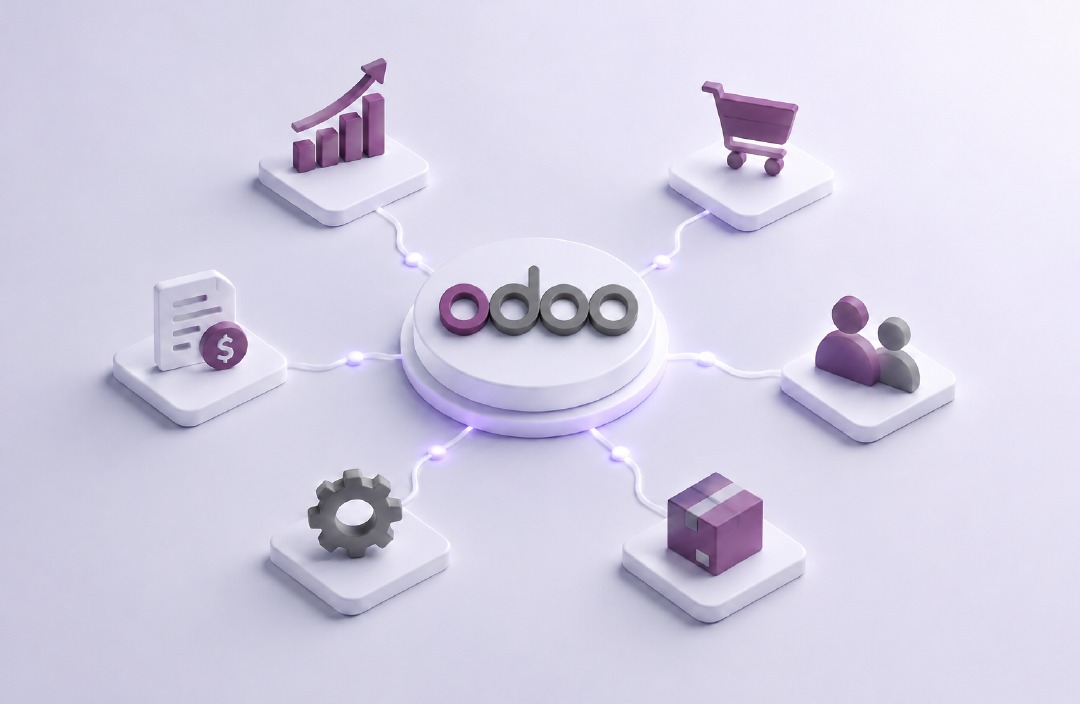
What Is Odoo ERP and Why Are Businesses Switching to It?
Every growing business eventually hits the same wall: too many tools, too little visibility, and too much time spent moving data between systems that were never designed to talk to each other. This is usually the point where the word “Odoo” starts coming up in conversations with IT consultants, finance teams, and operations managers looking for a better way to run day-to-day operations.
So what exactly is Odoo ERP, and why are so many businesses making the switch?
What Is Odoo? A Simple Explanation
Odoo is an all-in-one business management platform. Instead of running separate software for sales, inventory, accounting, HR, and customer relationship management, Odoo brings all of these functions into a single connected system. Every department works from the same underlying data, in real time, without manual exports, imports, or reconciliation between disconnected tools.
Think of it less as “one more piece of software” and more as the foundation that ties together the tools a business has already been trying to make work independently. Rather than five different logins and five different sets of records, there’s one platform and one version of the truth.
Core Odoo Modules at a Glance
Odoo is built around modules, each covering a specific business function. Some of the most commonly used include:
- Sales – manage leads, quotes, and orders in a single pipeline
- Inventory – track stock levels, warehouses, and movements in real time
- Accounting – handle invoicing, expenses, and financial reporting
- CRM – manage customer relationships, follow-ups, and communication history
- HR – handle employee records, attendance, and payroll-related processes
- Manufacturing – manage production orders, bills of materials, and quality checks
Businesses don’t need every module from day one. Most start with two or three core areas that address their most pressing pain points, then expand as needs grow and confidence in the system builds.
Is Odoo ERP Right for Small and Mid-Sized Businesses?
One of the most common misconceptions is that Odoo is only suitable for large enterprises with dedicated IT departments. In reality, its modular structure makes it just as practical for small and mid-sized businesses that need to keep costs proportional to their size. A company can begin with Sales and Inventory, then add Accounting and HR later, without needing to rip out and replace the entire system to accommodate growth.
This scalability is a large part of why Odoo has grown in popularity across industries as different as retail, manufacturing, professional services, and distribution. The same underlying platform adapts to very different operational needs depending on how it’s configured.
Key Benefits of Switching to Odoo
The businesses moving to Odoo are usually dealing with one or more of the following, often all at once:
- Data scattered across spreadsheets, email threads, and disconnected apps adopted individually over time
- Reports that take days to compile because information lives in different places and has to be manually reconciled
- Manual processes, re-entering data, cross-checking numbers, chasing updates, that eat up hours every week
- A growing team that has outgrown the ad-hoc systems that worked fine when the business was smaller
Odoo addresses these issues by consolidating operations into a single source of truth. When sales, inventory, and finance all update the same underlying data, reporting becomes accurate and immediate, and teams stop duplicating work across tools that were never meant to work together in the first place.
Getting Started with Odoo Implementation
Adopting Odoo isn’t just a matter of installing software and hoping for the best – it works best when the implementation is planned around how a business actually operates, not around a generic template. That’s where a structured implementation partner makes the difference between a system that gets used confidently and one that gets abandoned or underused after a few months because it never quite fit.
At Bittruster, we work with businesses to identify which modules matter most for their specific situation, configure the platform around existing workflows rather than forcing workflows to change unnecessarily, and support the transition from day one through go-live and well beyond.
A Practical First Step
If you’re not yet sure whether Odoo makes sense for your business, the most useful first step isn’t reading more feature lists – it’s having a conversation about what’s actually slowing your team down today. Whether that’s inventory accuracy, financial reporting, or simply too many tools that don’t talk to each other, the right starting point looks different for every business, and identifying it early makes the entire implementation more focused and considerably more likely to succeed in the long run.

Leave a Reply